




Recently, major news emerged in the innovative drug sector: the world’s first semaglutide nasal spray independently developed by Shanghai World Leader Pharmaceutical Co., Ltd.—a Class 2.2 improved new chemical drug—achieved dual clinical regulatory breakthroughs in China and the United States:
January 7, 2026: Successfully obtained U.S. FDA clearance to proceed with clinical trials;
January 7, 2026: Successfully cleared U.S. FDA clinical review;
January 12, 2026: Subsequently received implied clinical trial authorization from the Center for Drug Evaluation (CDE) of China’s National Medical Products Administration (NMPA).
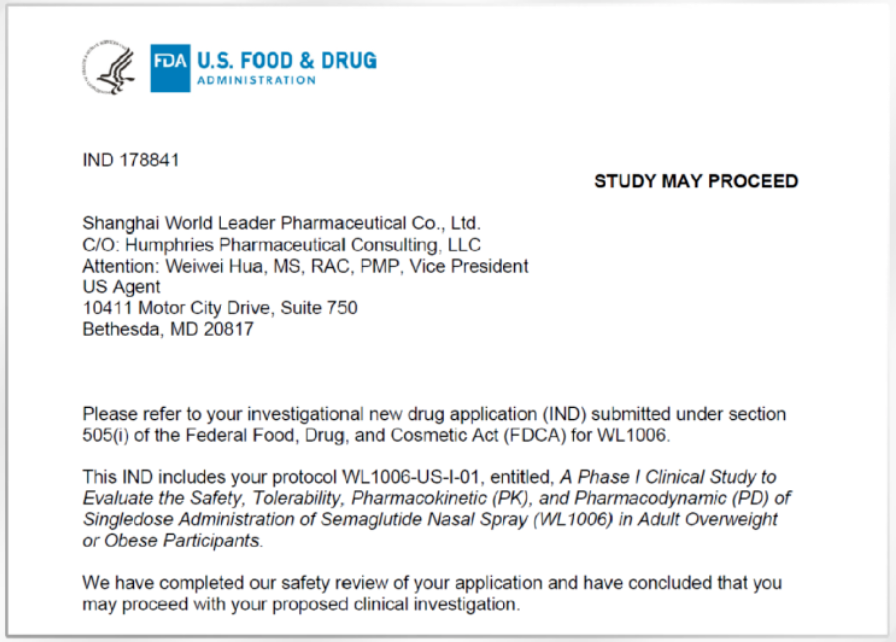
This marks the entry of this GLP-1 drug featuring a novel route of administration into the global clinical development stage.
As a key partner of Shanghai World Leader Pharmaceutical Co., Ltd., Milestone Pharma was deeply involved in the project. Drawing on its core technical strengths in drug compatibility studies and extensive experience with global regulatory submissions, Milestone Pharma provided critical support for the successful clinical approvals of this world-first innovative drug.
In this article, we take a closer look at the compatibility challenges and regulatory considerations behind this innovative drug.
01 Major Breakthrough
Key Features of the World’s First GLP-1 Nasal Spray
Shanghai World Leader Pharmaceutical’s independently developed semaglutide nasal spray represents not only a milestone for innovative pharmaceutical development in China, but also a significant advancement in drug delivery technology. Its key product features include:
1. Novel Dosage Form for Non-Invasive and Efficient Drug Delivery
This product is the world’s first transmucosal formulation of a GLP-1 receptor agonist. Its innovative nanoscale atomization design, in which fine particles account for more than 30%, is combined with an efficient absorption enhancer such as sodium caprylate, enabling the drug to be absorbed directly through the nasal mucosa into the systemic circulation.
This approach completely avoids the pain and inconvenience of invasive injections and also bypasses the hepatic first-pass effect of oral drugs, significantly improving patients’ willingness to use the medication and their long-term adherence. It is particularly well suited to people with a fear of needles.
2. Key Breakthrough in Bioavailability
Preclinical data show that the nasal spray achieved bioavailability of 37.1% to 52.1%, approaching the level of conventional injectable administration and successfully overcoming the long-standing technical bottleneck of low bioavailability associated with nasal delivery.
3. Potential Additional Therapeutic Value
The nasal route of administration offers another unique advantage: a portion of the drug can cross the blood-brain barrier directly. This creates the possibility of expanding the product in the future to new indications involving the central nervous system, such as binge-eating disorder and Alzheimer’s disease.
4. Independent Innovation and Global Development Strategy
This breakthrough stems from independent technological innovation in China and is expected to help break through the patent and technology barriers established by international leaders in the GLP-1 field. A Chinese invention patent application has been filed for the product, and global intellectual property protection is planned through the Patent Cooperation Treaty (PCT) route, laying a solid foundation for future entry into international markets.
02 Major Breakthrough
Key Challenges in Compatibility Studies for Nasal Sprays
While the product innovation is noteworthy, transforming a biological macromolecule such as semaglutide into a stable, safe, and effective nasal spray presents a series of significant technical challenges. Among them, compatibility studies of pharmaceutical packaging materials and delivery devices represent a critical and particularly demanding area of development. The major challenges include:
1. Complexity of a Drug-Device Combination Product
A nasal spray is essentially a drug-device combination product. This means that development must address not only the formulation itself, but also the interactions between the drug formulation and the delivery device.
The device materials, spray mechanism, atomization performance, and other characteristics can directly affect drug delivery efficiency, dose accuracy, and product stability.
2. Extremely High Analytical Sensitivity and Stringent Limits
As the client noted, “the limits for nasal sprays are very low.” Doses administered by the nasal route are generally much lower than oral or injectable doses, and the mucosal absorption area is limited. Therefore, the levels of leachables migrating from packaging or delivery devices into the formulation must be extremely low.
Compatibility studies therefore require the development of ultra-high-sensitivity analytical methods, such as LC-MS/MS and GC-MS, to detect and identify trace levels—even at the parts-per-trillion (ppt) level—of unknown leachables, followed by toxicological assessment to ensure that they remain within safe thresholds.
Even low-level migration of potentially harmful substances may present a risk due to local accumulation or systemic exposure.
3. Unique Nasal Environment and Precise Dose Control
The nasal cavity has a complex anatomical structure and is subject to mucociliary clearance mechanisms. Compatibility studies must therefore consider interactions between the formulation and the nasal environment.
At the same time, the delivery device must ensure consistent dose delivery, an appropriate droplet size distribution, and accurate deposition, primarily within the intended upper respiratory tract region. Variations in device performance, such as changes in spray force, may directly affect the delivered dose and therapeutic performance, creating substantial challenges for device compatibility, performance, and reliability validation.
4. Stringent Global Regulatory Requirements
For complex dosage forms such as nasal sprays, global regulatory authorities—including the FDA, CDE, and EMA—have extremely stringent requirements. They require not only bioequivalence of the formulation, but also a comprehensive evaluation of the similarity between a generic product and the reference product in manufacturing processes, devices, pharmacokinetics, and other relevant aspects.
As a core component of the regulatory submission dossier, compatibility studies must comply with the pharmacopeial requirements and guidelines of each country. Any omission may lead to rejection of the clinical trial application or stringent requests for supplementary information.
03 Expert Support
How Milestone Pharma Helps Address These Challenges
Supporting Global Regulatory Submissions
Given the highly demanding compatibility challenges described above, a partner with deep expertise and a global perspective is essential. Milestone Pharma is a leading provider of integrated solutions for complex dosage forms.
1. End-to-End Compatibility Study Services
Milestone Pharma provides pharmaceutical companies with end-to-end compatibility solutions for packaging materials and delivery devices, covering risk assessment, extractables studies, toxicological evaluation, analytical method development and validation for target compounds, and leachables studies.
The service scope covers all materials that contact the drug product throughout its lifecycle, including pharmaceutical packaging components such as vials and rubber stoppers, manufacturing process components such as filter membranes and silicone tubing, and clinical drug-delivery devices such as sprayers.
For nasal sprays and other drug-device combination products, Milestone Pharma can provide customized chemical characterization and migration assessment to evaluate potential interactions between the product and its packaging or delivery system.
2. Extensive Expertise and Comprehensive Database Support
Milestone Pharma has extensive project experience and has established a database covering more than 1,000 commonly encountered extractables, together with comprehensive extractables profiles for major polymeric materials.
These resources significantly accelerate the identification and risk assessment of unknown leachables.
The company’s expert team has been deeply involved in developing industry regulations and served as a principal drafter of the Technical Guidelines for Compatibility Studies of Chemical Drugs and Elastomeric Closures (Trial).
3. Supporting Global Regulatory Submissions
One of Milestone Pharma’s core strengths is its support for global regulatory submissions. Its controlled laboratory system complies with both cGMP and CNAS/ISO 17025 requirements, enabling it to provide study reports and toxicological assessment reports that meet the standards of major regulatory authorities and organizations, including China’s NMPA, the U.S. FDA, the EMA, and the WHO.
Milestone Pharma’s experts continuously monitor global regulatory developments and can provide optimal operating strategies for compatibility and container-closure integrity studies tailored to the specific requirements of different filing markets.
The company has also successfully addressed multiple recent FDA requests for supplementary information.
4. Specialized Support for Nanotechnology-Enabled Formulations and Emerging Technologies
For the nanoscale atomization technology potentially involved in the semaglutide nasal spray, Milestone Pharma also provides comprehensive nanomaterial characterization services, including monitoring changes in nanoparticle size and structure during storage and evaluating compatibility with the packaging system and route of administration.
These studies provide critical data to support manufacturing process changes and global regulatory submissions.
Conclusion
The clinical approval of the semaglutide nasal spray marks a striking step forward in dosage-form innovation for China’s pharmaceutical industry. However, moving from the laboratory to the global market requires overcoming the “invisible mountain” of compatibility studies.
With its comprehensive service capabilities, extensive professional databases, and deep understanding of global pharmaceutical regulations, Milestone Pharma can provide innovative pharmaceutical companies with solid support from early-stage research and development through global registration and regulatory submission.
Milestone Pharma is a reliable partner in overcoming the challenges of complex formulation development and helping pharmaceuticals “intelligently made in China” reach global markets.

