







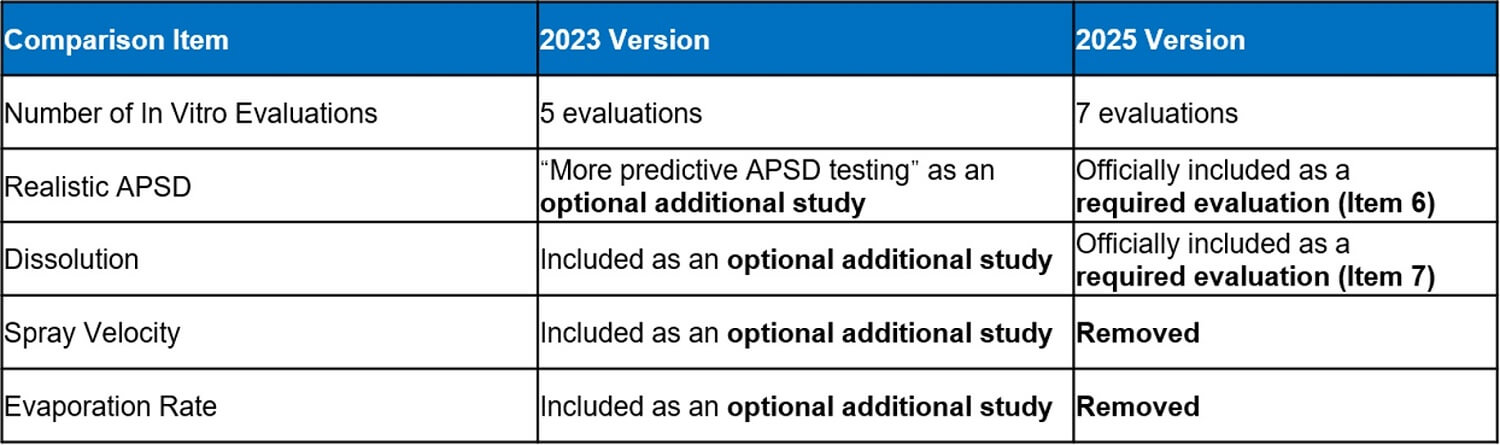
In November 2025, the FDA issued an updated Product-Specific Guidance (PSG) for the in vitro bioequivalence evaluation of beclomethasone dipropionate inhalation aerosol (pMDI). Compared with the August 2023 version, the in vitro evaluation framework has undergone a structural revision: realistic APSD and dissolution have been upgraded from optional additional studies to required studies, while spray velocity and evaporation rate have been removed.
Overall Comparison of the Evaluation Framework
2025: Seven-Study Pathway vs. 2023: Five-Study Pathway
Key Changes
The 2025 version establishes a more stringent in vitro evaluation framework by adding two required studies, potentially providing a pathway toward waiving comparative clinical endpoint studies where the applicable regulatory criteria are met.
Detailed Overview of the Seven In Vitro Evaluation Tests
1. Single-Actuation Content (SAC)
• Test stages: Beginning (B), Middle (M), and End (E)
• Airflow rate: 28.3 L/min or 30 L/min (30 L/min added as an option in the 2025 version)
• Statistical method: Population Bioequivalence (PBE)
Evaluation objective: To assess the consistency of the dose emitted per actuation.
2. Aerodynamic Particle Size Distribution (APSD)
• Test stages: Beginning (B) and End (E)
• Equipment: Cascade impactor, in accordance with USP <601>
• Data requirements: Drug deposition measurements from the mouthpiece, induction port, individual impactor stages, and final filter.
Evaluation objective: To characterize the distribution of drug deposition throughout different regions of the respiratory tract.
3. Spray Pattern
• Test distances: Two different distances, with a minimum separation of 3 cm and within a range of 3–7 cm
• Quantitative parameters: Ovality ratio and area, or Dmax
• Statistical analysis: PBE analysis combined with qualitative comparison of spray shape
Evaluation objective: To assess the geometric characteristics and symmetry of the spray pattern.
4. Plume Geometry
• Test distance: The larger of the two distances used for spray pattern measurements is used as the test distance for plume geometry.
• Quantitative parameters: Plume angle and plume width
• Equivalence criterion: The geometric mean ratio (T/R) falls within 90%–111%, with this numerical range explicitly specified for the first time in the 2025 version.
Evaluation objective: To characterize the dispersion profile of the aerosol plume after exiting the mouthpiece.
5. Priming and Repriming
• Basis: The number of priming and repriming actuations specified in the labeling of the Reference Listed Drug (RLD)
• Data source: The analysis may be based on SAC data collected at the Beginning (B) stage, as clarified in the 2025 version.
• Statistical analysis: Population Bioequivalence (PBE)
Evaluation objective: To assess dose delivery consistency following initial priming and subsequent repriming under conditions representative of actual use.
6. Realistic APSD — NEW
Upgraded to a Required Study
• Mouth-throat models: Different anatomical model sizes, such as small and large models
• Breathing profiles: Low- and high-intensity breathing profiles
• Key parameter: Impactor-Sized Mass (ISM)
• Supporting parameters: Mass Median Aerodynamic Diameter (MMAD), Geometric Standard Deviation (GSD), and Fine Particle Mass (FPM)
Evaluation objective: To characterize inhalation performance under conditions representative of different patient populations.
7. Dissolution — NEW
Upgraded to a Required Study
• Recommended apparatus: USP Apparatus 2/5 or a Transwell system
• Method requirement: The method should demonstrate discriminatory power, for example, the ability to differentiate between particles of different sizes.
• Comparison method: Similarity factor (f₂)
Evaluation objective: To characterize the drug release kinetics of inhaled particles in the lung.
One-Sentence Summary
The 2025 version expands the in vitro evaluation framework for pMDIs from five to seven studies, making realistic APSD and dissolution required assessments, explicitly defining a numerical equivalence range for plume geometry, and removing plume velocity and evaporation rate from the evaluation framework.
Milestone Pharma Services
For the in vitro evaluation of pMDIs and other Orally Inhaled and Nasal Drug Products (OINDPs), Milestone Pharma provides analytical services covering Single-Actuation Content (SAC), Aerodynamic Particle Size Distribution (APSD), Spray Pattern, Plume Geometry, Priming and Repriming, Realistic APSD, and Dissolution.
These services support inhalation drug product development, in vitro bioequivalence studies, and global regulatory submissions.

