







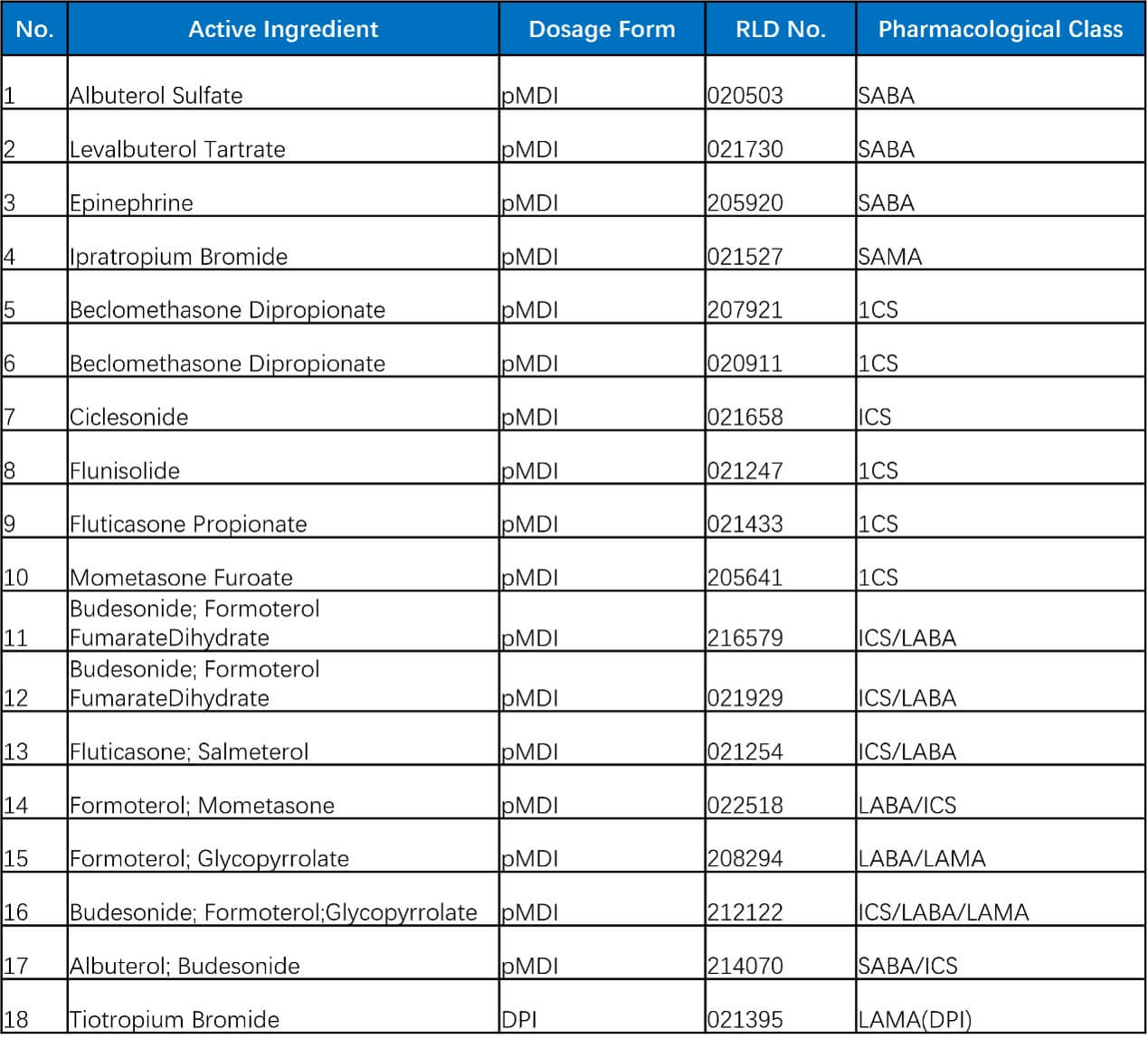
On May 21, 2026, the U.S. Food and Drug Administration (FDA) simultaneously updated 18 Product-Specific Guidances (PSGs) for inhalation drug products, including 17 pressurized metered-dose inhalers (pMDIs) and 1 dry powder inhaler (DPI). The updated PSGs cover major products such as albuterol, beclomethasone, budesonide/formoterol, and fluticasone/salmeterol.
This represents the largest single-round revision of inhalation product-specific guidances since the FDA began issuing PSGs in 2013, signaling a systematic shift in the framework for in vitro bioequivalence (BE) evaluation.
01.What Has Changed?
Table 1. Inhalation Product-Specific Guidances Updated on May 21, 2026
❌ Five Evaluations Removed (Three Evaluations Removed in This Update: Spray Pattern, Plume Geometry, and Priming/Repriming):
• Together with spray velocity and evaporation rate, which were removed in the previous revision, five evaluations have been removed in total
➕ Two Evaluations Added or Upgraded:
• Realistic APSD (rAPSD) was upgraded from an optional evaluation to a required evaluation.
• Dissolution testing was elevated from a development tool to a BE evaluation attribute, where applicable to products containing corticosteroids.
02.Why Did the FDA Make These Changes?
The comprehensive revision reflects more than a decade of accumulated FDA regulatory science and scientific evidence, driven primarily by two factors.
Challenges Associated with CCEP/PD Studies
Comparative Clinical Endpoint (CCEP) and Pharmacodynamic (PD) studies face several inherent challenges, including high variability, often requiring more than 2,000 subjects; limited sensitivity, particularly when exposure–response relationships are relatively flat; and high costs and lengthy timelines.
These limitations have created a strong need for more efficient and scientifically sensitive alternatives for demonstrating bioequivalence.
Accumulation of Scientific Evidence
At the 2023 CRCG workshop, rAPSD and dissolution testing were identified as among the most useful alternative tools. Further research by Bielski and Newman, presented at RDD 2026, provided additional evidence indicating that:
1. rAPSD is sufficiently sensitive to capture the relevant differences detectable through Spray Pattern and Plume Geometry evaluations, reducing the scientific need to maintain these as separate standalone assessments.
2. Priming/Repriming provides information that overlaps with the beginning-of-life (B-stage) SAC evaluation, resulting in substantial redundancy.
Based on these findings, the FDA has streamlined the in vitro evaluation framework from seven assessments to a core four-part framework: SAC + APSD + rAPSD + Dissolution, where dissolution is applicable.
This represents a combination of removing redundant evaluations while introducing more clinically relevant evidence. The proportion of products for which an alternative BE pathway is available has increased from 0% in 2018 to more than 90% in 2026, making alternative BE approaches increasingly central to inhalation product development.
03.rAPSD and Dissolution: The New Core of In Vitro Evaluation
01.rAPSD: From Standardized Conditions to Real-World Patient Conditions
Traditional APSD testing is generally performed using standardized induction ports and predefined flow rates, representing relatively idealized test conditions.
In contrast, rAPSD incorporates clinically relevant variability across patient populations, making in vitro evaluation more representative of real-world inhalation conditions.
The key design elements include:
• Anatomical models: Multiple mouth–throat geometries, such as the Alabama mouth–throat model, covering different anatomical dimensions from pediatric to adult populations.
• Breathing profiles: Multiple inhalation flow profiles designed to represent patients with different inhalation capabilities.
• Bracketing approach: Selection of extreme combinations, such as small mouth–throat geometry with weak inhalation and large mouth–throat geometry with strong inhalation, to cover a broad range of patient variability with a limited number of experimental runs.
• Statistical analysis: Impactor Stage Mass (ISM) is evaluated using PBE analysis for each mouth–throat and breathing-profile combination. Equivalence is demonstrated when all predefined combinations meet the applicable criteria.
The key value of rAPSD is its ability to address the limitations of conventional APSD testing in representing actual inhalation performance across different patient populations.
Research presented at RDD 2026 further indicated that rAPSD can capture not only information provided by conventional APSD, but also device-related performance differences previously reflected by Spray Pattern and Plume Geometry. This scientific evidence provides an important basis for the FDA's decision to remove these two evaluations as separate standalone tests.
02.Highlight 2: Dissolution Testing — From a Development Tool to a Key BE Attribute
Dissolution testing has evolved from primarily being a formulation development tool into a bioequivalence evaluation attribute. However, it is not necessarily required for every inhalation product, reflecting the FDA's product-specific and risk-based approach.
• Required where applicable: Corticosteroid-containing products — dissolution behavior in airway mucus may directly affect local drug exposure and duration of pharmacological action.
• Combination products: For combination inhalation products, dissolution evaluation may be required at least for the inhaled corticosteroid (ICS) component, where applicable.
Recommended dissolution systems include USP Apparatus 2 (Paddle), Apparatus 5 (Paddle over Disk), or Transwell-based systems.
The analytical method should possess adequate discriminatory capability, and dissolution profiles may be compared using the f₂ similarity factor, where applicable.
04.In Vitro BE Evaluation Framework
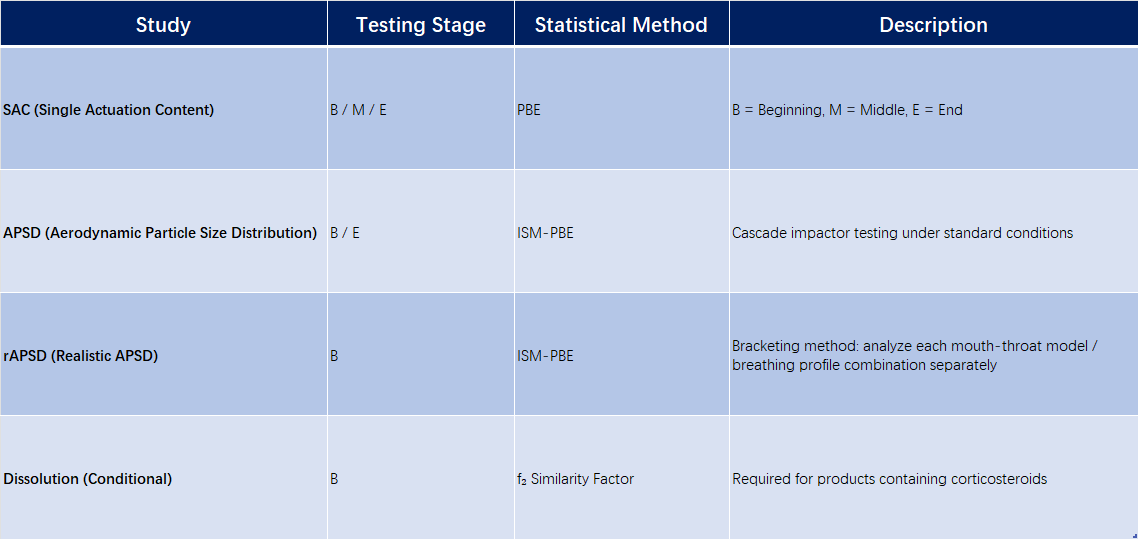
The 2026 PSG framework for in vitro BE evaluation can be summarized as a “3+1” structure:
Three core evaluations — SAC + APSD + rAPSD — applicable across the relevant inhalation products, plus one conditional evaluation — Dissolution — applicable to products containing corticosteroids where required.
Table 2. Core In Vitro BE Evaluations
05.Implications for Drug Developers
Accelerated Development
The in vitro evaluation package has been streamlined from seven assessments to approximately three to four core evaluations. Under an applicable Option 1 pathway, CCEP/PD studies may be avoided, potentially reducing development timelines, study complexity, and overall development costs.
Higher Technical Requirements
At the same time, the technical requirements have become more sophisticated.
rAPSD requires the capability to control and characterize multiple mouth–throat geometries and inhalation profiles, while dissolution testing requires the development of product-specific methods with adequate discriminatory power.
These capabilities represent important new technical requirements for inhalation drug developers.
Implications for DPI Development
The inclusion of a DPI product, such as tiotropium bromide, indicates that the alternative BE framework may continue expanding across a broader range of inhalation dosage forms.
DPI developers should therefore closely monitor methodological developments related to rAPSD and other advanced in vitro performance evaluations.
06.Milestone Pharma's In Vitro BE Capabilities for Inhalation Drug Products
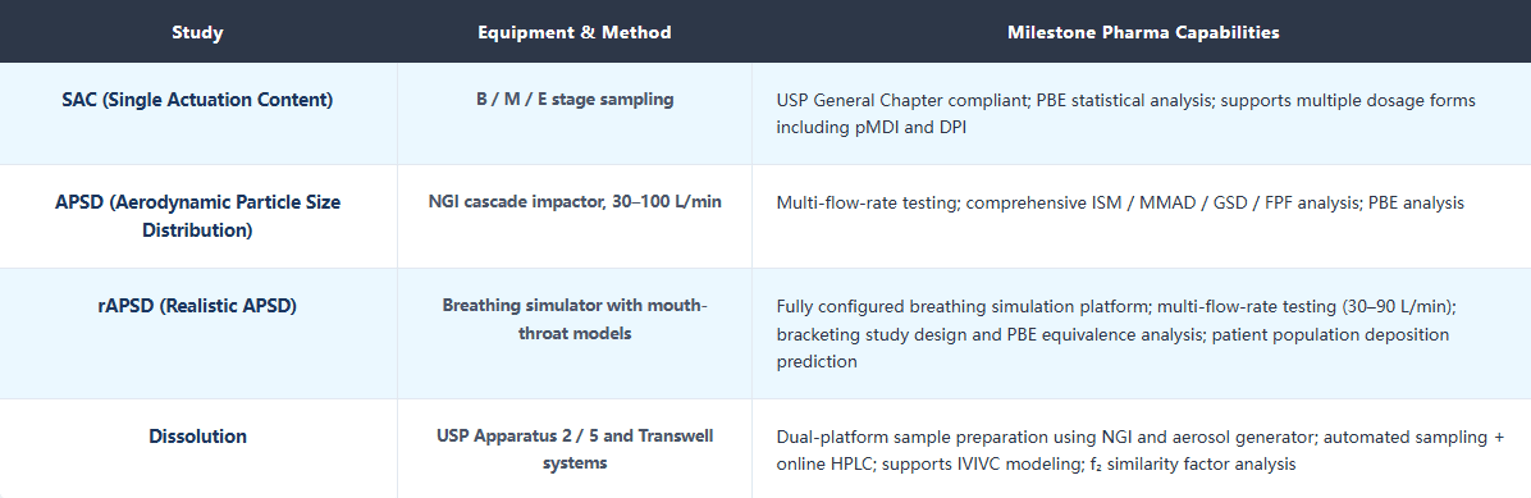
Table 3. Milestone Pharma's Core In Vitro BE Capabilities for Inhalation Drug Products
Core Advantage 1: Regulatory Alignment
Regulatory alignment — Milestone Pharma develops data packages and technical reports aligned with the expectations of FDA, EMA, and NMPA, and has successfully undergone multiple FDA inspections.
Core Advantage 2: Comprehensive Technical Platform
Comprehensive platform capabilities — Milestone Pharma has established integrated testing capabilities covering the four key technologies of SAC, APSD, rAPSD, and dissolution, enabling one-stop execution of the applicable in vitro BE studies outlined in the 2026 PSG framework.
Core Advantage 3: Method Development Expertise
Method development expertise — Milestone Pharma has extensive experience in critical technical areas, including dissolution sample preparation using both NGI cascade impactor collection and aerosol generator collection platforms, as well as rAPSD bracketing study design.
These capabilities enable efficient development of product-specific analytical methods with appropriate discriminatory power, supporting inhalation drug developers in generating robust data for regulatory submissions.
Conclusion
With the FDA's 2026 comprehensive update of inhalation product-specific guidances, in vitro BE evaluation for inhalation drug products is moving away from a broad, multi-test framework toward a more focused, science-driven approach centered on SAC, APSD, rAPSD, and dissolution testing where applicable.
For drug developers, this evolution may enable more efficient BE development pathways, while simultaneously raising the technical bar for realistic inhalation simulation, device performance characterization, dissolution method development, and statistical analysis.
Leveraging its comprehensive in vitro inhalation drug product evaluation platform, Milestone Pharma provides integrated capabilities covering SAC, APSD, rAPSD, and dissolution testing, together with method development, analytical testing, statistical analysis, technical reporting, and regulatory submission support.
Through these integrated services, Milestone Pharma supports clients in efficiently navigating the evolving global regulatory landscape for inhalation drug products.

