







Inhalation drug products are a key dosage form for the treatment of respiratory diseases. Dry powder inhalers (DPIs) offer advantages such as being propellant-free, breath-actuated, portable, and easy to use, and are widely used in the treatment of respiratory conditions including asthma and chronic obstructive pulmonary disease (COPD).
However, DPI performance is highly dependent on particle size, inspiratory flow rate, and particle morphology, all of which can affect powder flowability and pulmonary deposition. Particles in the approximate 1–5 μm range are generally capable of reaching the deeper regions of the lungs. As a result, DPI in vitro quality evaluation and equivalence studies require sophisticated analytical platforms and well-established technical capabilities.
Core Positioning and Value
Leveraging FDA Product-Specific Guidances (PSGs) and a regulatory framework supporting dual submissions in China and the United States, Milestone Pharma has established a one-stop in vitro evaluation platform for dry powder inhalers (DPIs).
The platform covers five core analytical dimensions to comprehensively support inhalation drug product development, generic drug submissions, and consistency evaluation,providing clients with efficient, compliant, and submission-ready technical solutions.
• Applicable dosage form: Dry Powder Inhalers (DPIs)
• Regulatory framework: FDA PSGs, USP <601>/<1604>, General Chapters of the Chinese Pharmacopoeia (ChP) Volume IV <0111>/<0951>, and NMPA consistency evaluation requirements
• Core value: Addressing key quality and performance challenges associated with flow-rate sensitivity, particle-size dependence, and formulation–device interactions, while using robust in vitro data to support in vivo performance and regulatory equivalence evaluation.
Five Core In Vitro Evaluation Technologies
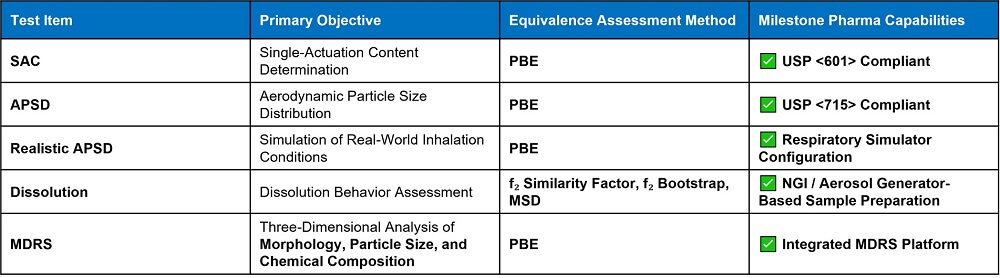
1. Single Actuation Content (SAC)
Single Actuation Content (SAC) measures the total amount of drug delivered upon each device actuation. Unlike Delivered Dose Uniformity (DDU), which focuses on the dose actually delivered to the patient during inhalation, SAC is used to evaluate the consistency of the device’s actuation performance and minimize the influence of device-related variability on dose delivery, and to supports comparative in vitro equivalence assessment between test (generic) and reference products.
Testing is performed using a Dose Unit Sampling Apparatus (DUSA) and HPLC analysis, with sampling conducted at the beginning, medium and end of the product life stage. The resulting data can be evaluated using Population Bioequivalence (PBE) statistical analysis in accordance with applicable FDA criteria.
2. Aerodynamic Particle Size Distribution (APSD)
Aerodynamic Particle Size Distribution (APSD) is evaluated using a cascade impactor, such as a Next Generation Impactor (NGI) or Andersen Cascade Impactor (ACI), under relevant inhalation flow conditions.
Key parameters include Impactor-Sized Mass (ISM), Mass Median Aerodynamic Diameter (MMAD), Geometric Standard Deviation (GSD), and Fine Particle Fraction (FPF). Representative target attributes are an MMAD in the range of 2–4 μm, a GSD of ≤ 2.0, and an FPF of ≥ 50% for the given formulation and device. As the recognized gold standard for DPI performance, APSD is directly linked to the site of drug deposition within the lungs and, consequently, to clinical therapeutic performance.
For generic products, comparative APSD data can be evaluated using PBE statistical analysis in accordance with the applicable FDA Product-Specific Guidance (PSG) criteria.
3. Realistic APSD (APSD Determined under Realistic Inhalation Profiles)
Unlike conventional APSD testing conducted at a fixed flow rate, Realistic APSD is designed to better simulate real-world patient inhalation behavior.
The evaluation can incorporate multiple inhalation flow profiles (e.g., 30–90 L/min), variations in inhaled volume (lung volume), and relevant environmental temperature and humidity conditions, helping characterize inhalation performance across different patient populations, including pediatric patients, elderly patients, and patients with COPD.
This approach can support device resistance optimization, generic drug development and regulatory submissions, and patient-use considerations, with comparative data evaluated using appropriate PBE statistical approaches where applicable.
4. In Vitro Dissolution Testing
As acknowledged by FDA, pulmonary dissolution behavior can influence the rate of drug absorption and systemic bioavailability. In vitro dissolution testing therefore provides valuable information for formulation development, quality control, bioequivalence assessment, and in vitro–in vivo correlation (IVIVC) studies.
Sample preparation should simulate the deposition of aerosolized drug in the lungs. Common approaches include drug collection using an NGI cascade impactor and collection using an aerosol generation system.
Dissolution testing may employ flow-through cells, paddle apparatus, or Transwell systems, with dissolution media such as fasted-state simulated lung fluid (FaSSLF) or phosphate buffer solution. Comparative assessment may include the similarity factor (f₂) where appropriate.
5. Morphologically Directed Raman Spectroscopy (MDRS)
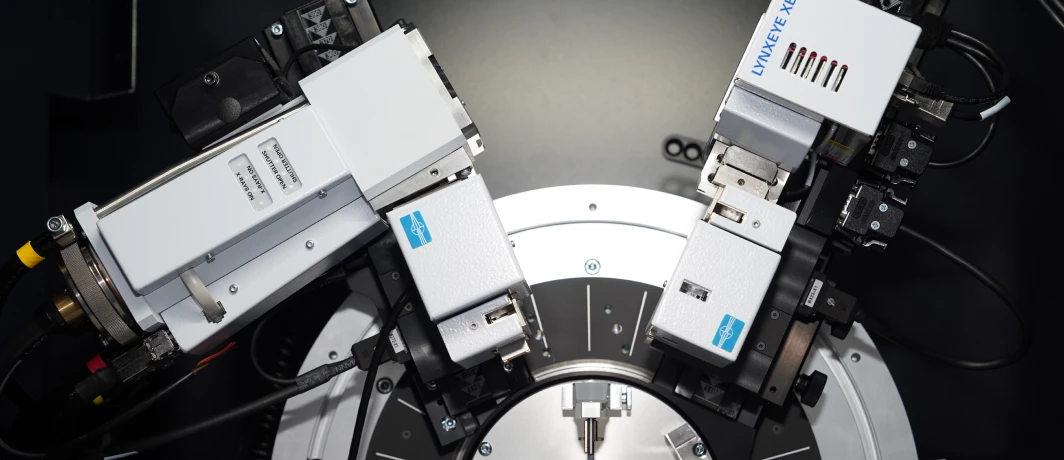
Morphologically Directed Raman Spectroscopy (MDRS) integrates automated particle morphology analysis, particle size distribution measurement, and Raman spectroscopic chemical identification, enabling correlated, particle-level characterization of particle morphology, size, and chemical composition.
The technology is particularly useful for identification and differentiation of API and carrier particles in complex DPI formulations, polymorph characterization, and impurity investigation.
Morphological parameters may include circularity, aspect ratio, irregularity, convexity, and surface roughness. Particle size parameters include D10, D50, D90, and Span, while chemical identification is based on Raman spectral fingerprints.
Comparative evaluation may incorporate PBE statistical analysis and predefined Raman spectral similarity criteria, such as a similarity threshold of ≥95%, where applicable.
Comparative Overview of the Five Core Technologies
NMPA Regulatory Support in China
The National Medical Products Administration (NMPA) has established technical requirements for DPI consistency evaluation that are largely aligned with the FDA framework, including SAC, APSD, Realistic APSD, dissolution testing, and particle characterization such as MDRS.
Milestone Pharma has comprehensive technical and quality capabilities to support dual regulatory submissions in China and the United States.
Milestone Pharma Technical and Service Capabilities
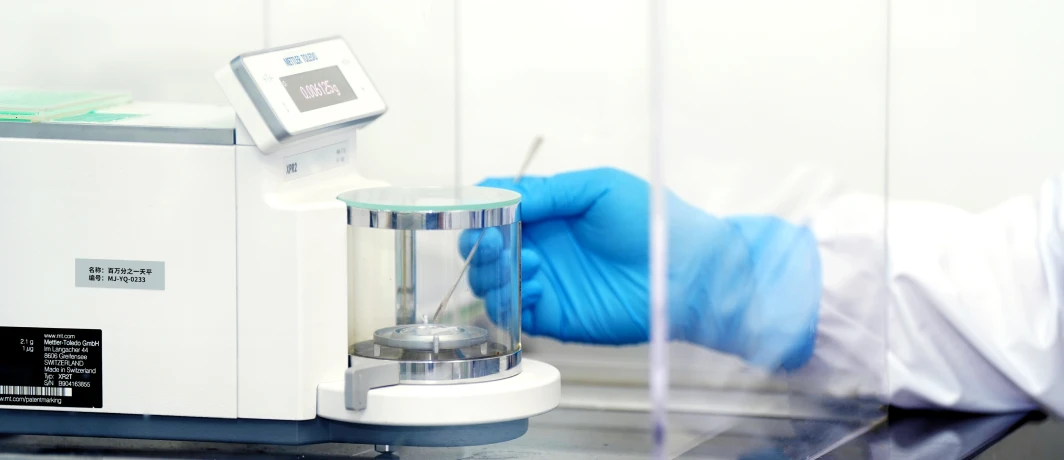
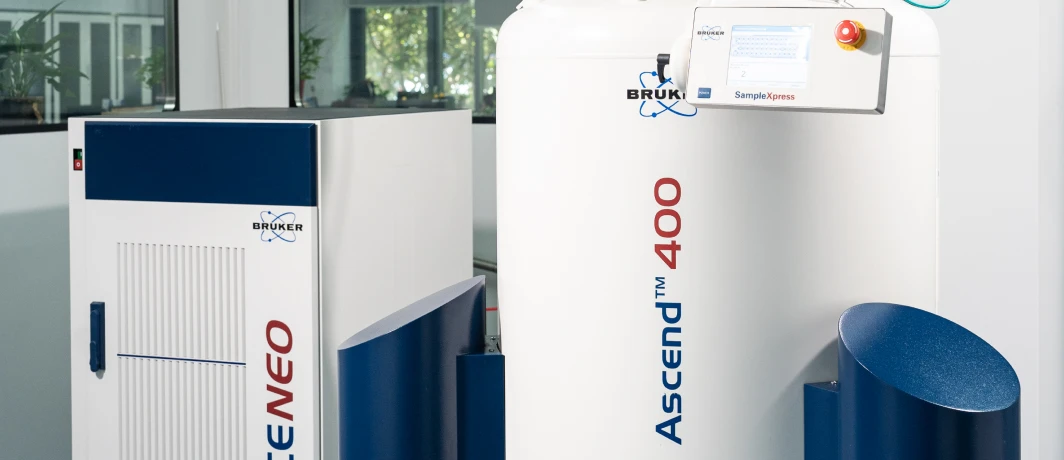
Milestone Pharma is equipped with Dose Unit Sampling Apparatus (DUSA), NGI cascade impactors, breathing simulators, automated dissolution systems, and an integrated MDRS platform.
The laboratory follows ALCOA+ data integrity principles and uses validated, licensed SAS software for PBE statistical analysis. Testing programs typically cover at least three batches, with at least 10 test units per batch, across multiple inhalation flow rates and multiple life-cycle stages, as required by the applicable study protocol and regulatory guidance.
Milestone Pharma also provides detailed technical reports and regulatory dossier (submission documentation) writing support.
Conclusion
In summary, based on applicable FDA Product-Specific Guidances (PSGs), Milestone Pharma provides a one-stop in vitro evaluation solution for DPIs covering five core technologies: SAC, APSD, Realistic APSD, Dissolution, and MDRS.
With a focus on regulatory alignment in both China and the United States, Milestone Pharma supports inhalation drug product development, consistency evaluation, and regulatory submissions—helping ensure precise drug delivery with every microgram and reliable performance with every inhalation.
In our upcoming articles, we will take an in-depth look at each of the five core technologies—SAC, APSD, Realistic APSD, Dissolution, and MDRS. Stay tuned for more technical insights from Milestone Pharma.

