






01 Iron Sucrose: The Most Widely Used Intravenous Iron Supplement Worldwide
Iron sucrose (IS) injection is a nanocolloidal drug formed by the complexation of a polynuclear iron (III) hydroxide core with a sucrose ligand. Marketed under the brand name Venofer®, it is clinically used to treat iron-deficiency anemia (IDA) in patients with chronic kidney disease (CKD). As a representative product of non-biological complex drugs (NBCDs), Iron Sucrose has annual global sales exceeding $500 million and is the most widely used and clinically applied product in the intravenous iron therapy market. In August 2025, the FDA successively approved generic versions of Iron Sucrose Injection (ANDA) submitted by Viatris and Amphastar, marking the launch of the first generics for this product. In the revised Product-Specific Guidance (PSG) issued by the FDA during the same period, the agency explicitly required generic formulations to provide in-vivo PK data, in-vitro particle size characterization, and more detailed comparative characterization studies, significantly raising the technical bar. For companies currently developing Iron Sucrose generics, the systematic approach and depth of their CMC research directly determine the success or failure of their regulatory submissions.
Key Points:
Iron Sucrose is not a “small-molecule generic drug” in the traditional sense. Its API is a complex formed “in situ” during the formulation process and lacks a clearly defined single molecular structure. This means that the consistency of the generic drug with the reference product cannot be demonstrated solely by content and impurities. Instead, systematic orthogonal characterization must be conducted from the perspective of overall particle properties.
02 Core CMC Challenge: An API “Without a Defined Structure”
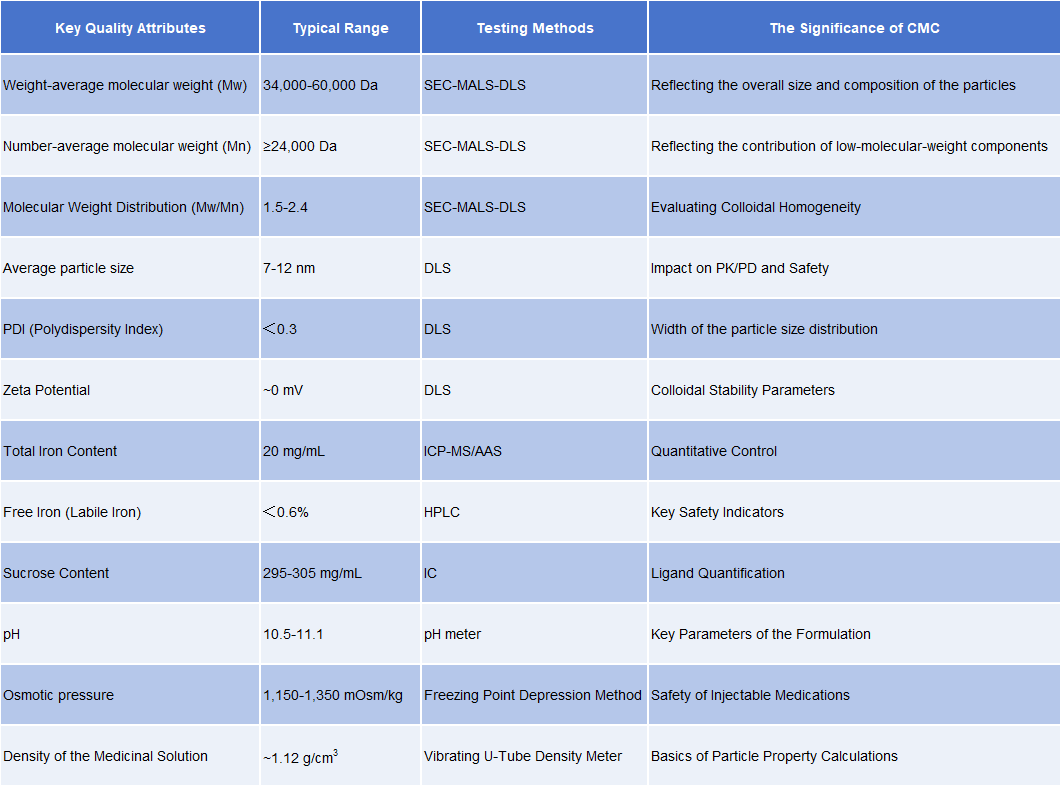
CMC research on Iron Sucrose faces a fundamental challenge: its active ingredient is not a single chemical entity, but rather a complex nanocolloid formed during the formulation process. This complex is assembled from a ferric hydroxyl oxide (FeOOH) core and a sucrose shell through various interactions, including coordination bonds, hydrogen bonds, and van der Waals forces. It has a weight-average molecular weight (Mw) of approximately 34,000–60,000 Da, a particle size of approximately 7–12 nm, and a pH of 10.5–11.1. This means that even if the “content” of Iron Sucrose API is the same for two different manufacturers, the overall particle properties of their nanocolloids—including particle size distribution, molecular weight distribution, aggregation state, and density characteristics—may differ significantly, and these differences directly affect the drug’s safety and efficacy. The traditional evaluation pathway for small-molecule generic drugs (content + impurities + dissolution) is completely ineffective in this context.
Overview of Key Quality Attributes (CQAs) for Iron Sucrose
03 Regulatory Framework: Orthogonal Characterization Has Become a Mandatory Requirement for Regulatory Filings
In recent years, regulatory authorities in China, the U.S., and Europe have continuously strengthened requirements for studying the overall particle properties of colloidal iron products; orthogonal characterization has evolved from a “R&D strategy” to a “regulatory requirement.”
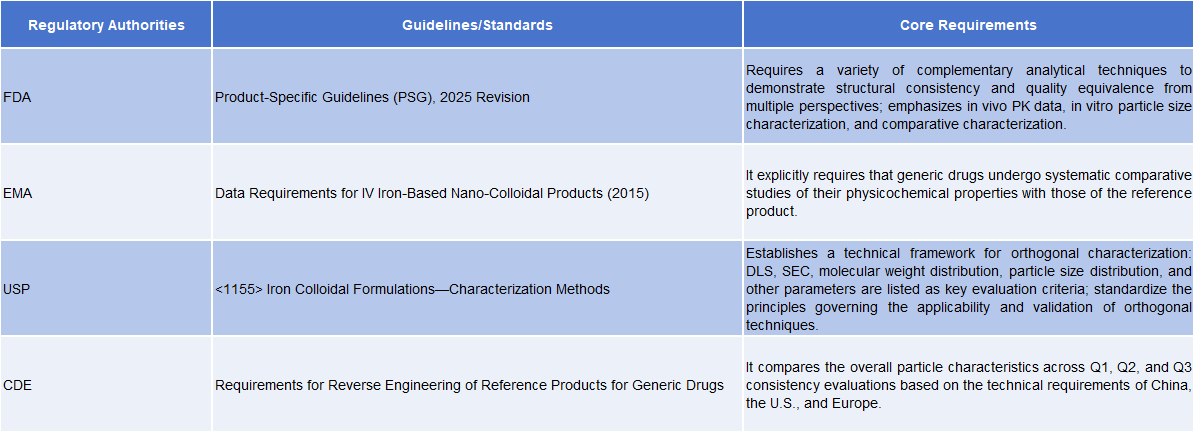
USP <1155> Key Points
“Multiple orthogonal physical characterization methods must be employed to fully understand the reference product; generic formulations should be consistent with the reference product to ensure product safety and efficacy.”—This implies that characterization results from a single technique (such as DLS alone or SEC alone) are insufficient to support a registration application; a multi-technique orthogonal system must be established.
04 Milestone Pharma: Six Major Orthogonal Characterization Technology Systems
Leveraging a mature multi-technology integration platform, Milestone Pharma has established six orthogonal characterization systems—comprising DLS, SEC-MALS-DLS, AUC, high-precision density measurement, and dn/dc measurement—focused on the particle size, molecular weight, conformation, sedimentation behavior, aggregation state, solution density, particle density, and optical parameters of intravenous iron preparations. These distinct technologies are based on independent physical principles and analyze nanocolloidal particles from different dimensions, thereby reducing the resultant biases in a single method caused by model assumptions, sample separation, or signal weighting methods.
1、Particle Size and Size Distribution Analysis (DLS)
Brownian motion causes the intensity of light scattered by nanoparticles to fluctuate over time. The translational diffusion coefficient Dt is obtained through analysis of the autocorrelation function and converted to the hydrodynamic diameter Dh using the Stokes–Einstein equation.
Key Outputs:
· Z-average: Intensity-weighted average particle size, a parameter defined by ISO 22412
· PDI (Polydispersity Index): <0.1 indicates a narrow distribution, 0.1–0.3 indicates a moderate distribution, and >0.3 indicates a broad distribution
· Number Distribution: A number-weighted characterization of particle size distribution, more suitable for nanocolloidal systems such as iron sucrose
Technical Notes:
The collective diffusion effect of free sucrose present in iron sucrose formulations can interfere with the accurate determination of iron core particle size via DLS. Milestone Pharma employs a number distribution approximation for data analysis, effectively eliminating interference from free sucrose signals to obtain a more accurate iron core particle size (approximately 7 nm).
2、Absolute Molecular Weight and Conformation Analysis (SEC-MALS-DLS)
SEC separates samples based on hydrodynamic volume, while MALS measures the absolute molar mass of each eluted volume in real time (without the need for standard calibration). Online DLS simultaneously provides the hydrodynamic radius (Rh) of each eluted component, and RID provides the concentration. The four-detector coupling (UV-MALS-DLS-RID) enables the simultaneous characterization of molecular weight, conformation, particle size, and composition.
Key Outputs:
· Mw (weight-average molecular weight): absolute value, first-principles calculation, independent of column calibration
· Mn (number-average molecular weight): reflects the contribution of low-molecular-weight components
· Mw/Mn (polydispersity): molecular weight distribution width
· Rh (hydration radius): online particle size derived from QELS
· Rg (gyration radius): obtained from angle-dependent fitting of MALS data
· Rg/Rh ratio: shape factor; ≈0.775 for spheres; deviations reflect non-sphericity
3、Aggregation State Analysis (AUC Analysis via Ultracentrifugation)
Under ultracentrifugation, nanoparticles settle at different rates depending on their size, shape, and density. The settling process is recorded via real-time optical detection (UV/interferometric/multi-wavelength), and molecular weight is calculated directly based on the Svedberg equation.
Key outputs:
· Sedimentation coefficient distribution c(s): A continuous distribution curve with resolution far superior to that of chromatography
· Molecular weight distribution c(M): Obtained from a joint fit of s and D
· Aggregate quantification: Precise quantification of the main peak and the proportion of polymers
4、Density Measurement of Pharmaceutical Solutions
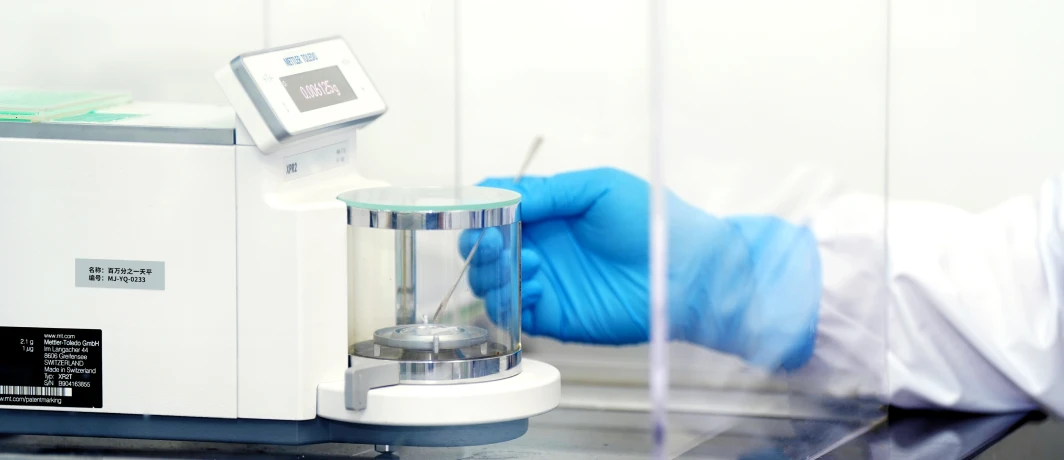
A high-precision vibrating U-tube densitometer (accuracy: ±5×10⁻⁶ g/cm³; temperature control accuracy: ±0.01°C) is used to measure the absolute density of the formulation, providing foundational data for the overall evaluation of particle properties and the calculation of related parameters.
Key Outputs:
· Absolute density of the drug solution: ρsolution (g/cm³, 20°C or 25°C)
· Temperature-dependence curve: Density-temperature relationship (15–40°C), to evaluate changes under storage and administration conditions
5、Nanoparticle Density Analysis (Partial Specific Volume v̄)
Partial specific volume v̄ represents the change in solution volume caused by the addition of one gram of solute. The DMA 5001 M is used to measure the density of the solution at multiple concentration points; the reciprocal of density is plotted against the concentration, and the slope gives v̄. This parameter is a key input for AUC molecular weight calculations and SEC-MALS data analysis.
Key Output:
l Partial specific volume v̄ (mL/g): An intrinsic density parameter of nanoparticles
l Particle density ρparticle: Derived from v̄ (ρparticle = 1/v̄)
l Concentration Dependence: Evaluates whether particles aggregate or undergo structural changes at different concentrations
6、Determination of Refractive Index Increment (dn/dc)
dn/dc is the rate at which the refractive index of a solution changes with solute concentration, expressed in mL/g. In static light scattering measurements, the excess scattered light intensity detected by MALS is proportional to (dn/dc)². Therefore, dn/dc is the primary input parameter for calculating absolute molecular weight via SEC-MALS-DLS—a 1% deviation in dn/dc will result in a 2% systematic error in Mw.
Key Output
l dn/dc value (mL/g, at a specified wavelength and temperature)
l Provides precise optical constant inputs for SEC-MALS absolute molecular weight calculations
05 Why “One Technique Is Not Enough”: The Synergy of Six Major Systems
The nanocolloidal properties of Iron Sucrose dictate that no single characterization technique can comprehensively describe its quality attributes. Milestone Pharma’s six orthogonal characterization systems, through cross-validation based on different physical principles, construct a complete “profile” of particle properties:
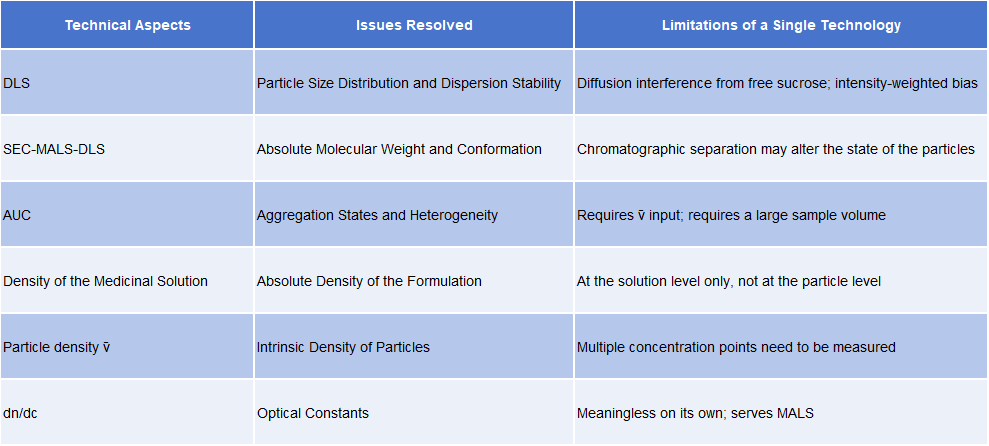
The Core Value of Orthogonal Characterization:
The six technologies cross-validate and complement one another: DLS provides a “snapshot” of particle size, SEC-MALS-DLS offers a “panorama” of molecular weight, AUC reveals “blind spots” in aggregation, and density along with dn/dc provide the “foundation” for calculations. Only when multiple independent techniques point to the same conclusion can we be certain that a generic drug is truly equivalent to the reference product in terms of its overall particle properties.
06 Milestone Pharma’s One-Stop CMC Services
One-Stop Service from Characterization to Submission
Milestone Pharma not only provides orthogonal characterization services but has also established an integrated service capability covering the entire CMC research chain for Iron Sucrose:
1. Reference Product Reverse Engineering (Q1/Q2/Q3)
Systematic reverse engineering of the reference product Venofer® to determine the formulation composition (Q1), the proportions of each component (Q2), and key quality attributes (Q3), providing a precise “target” for generic drug development.
2. One-Stop CMC Service for APIs and Formulations
We provide end-to-end CMC turnkey services ranging from API synthesis process development, structural characterization, and quality studies to formulation development, process scale-up, and stability studies, supporting regulatory submissions for innovative drugs, improved new drugs, and generic drugs.
3. Comprehensive Orthogonal Characterization of Particle Properties
Six major orthogonal technical systems (DLS/SEC-MALS-DLS/AUC/density/v̄/dn/dc) cover all key particle properties of Iron Sucrose, meeting the technical requirements for registration and submission of colloidal iron products set by the FDA, EMA, and CDE.
4. Impurity Studies and Safety Evaluation
Quantification of labile iron, determination of the divalent-to-trivalent iron ratio, reduction kinetics (using T75 as a bioequivalence marker), elemental impurities (ICP-MS), and risk assessment of organic impurities—comprehensively covering all safety evaluation requirements for Iron Sucrose.
5. Sterility Assurance and Packaging Material Compatibility
For Iron Sucrose Injection products, Milestone Pharma provides a comprehensive sterility assurance system (validation of sterilizing filtration processes, validation of disinfectant efficacy, and validation of cleanroom systems) as well as packaging material compatibility and seal integrity studies to ensure product safety.
6. Global Regulatory Filing Support
We support the preparation and compilation of all pharmaceutical study data required for registration submissions to the FDA (ANDA/DMF), EMA, and CDE, including studies in response to requests for additional information and post-marketing change studies.
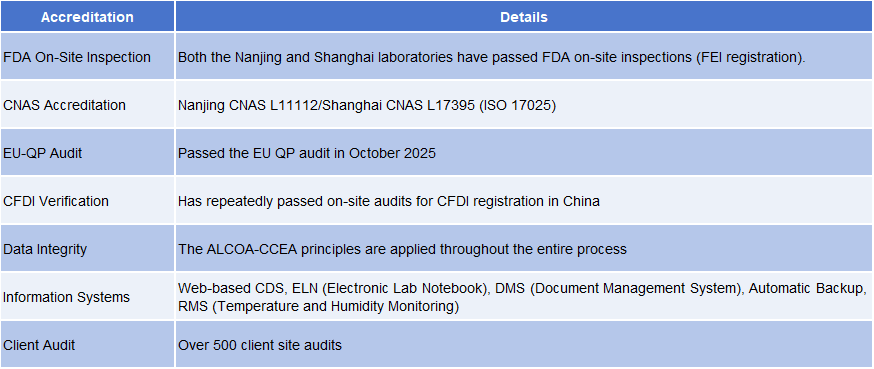
07 Quality System Assurance
Milestone Pharma’s quality management system has received multiple official certifications, providing a solid foundation for the reliability of Iron Sucrose CMC research data:
08 Service Application Scenarios
Generic Drug Comparative Characterization:
Comparative studies with the reference product for FDA, EMA, and CDE submissions, and a multi-batch database of its particle properties
Formulation and Process Change Studies:
Evaluate whether overall particle properties remain consistent before and after changes, providing scientific justification for the changes
Batch Consistency Evaluation:
Establish a database of overall particle properties across multiple batches to support the establishment of quality standards and ongoing process validation
Technology Transfer Evaluation:
Verify the consistency of product particle properties before and after technology transfer to ensure that product quality remains unchanged following the transfer
Competitor and Reference Product Analysis:
Systematically compare differences in overall particle properties across different products to provide a basis for product development and project approval decisions
Conclusion
As a non-biological complex drug (NBCD), the core of CMC research for Iron Sucrose does not lie in whether “the content is correct,” but rather in whether “the particles are consistent.” Against the backdrop of the FDA’s approval of the first generic and continuously tightening regulatory requirements, orthogonal characterization has evolved from an optional approach to a mandatory one. Leveraging its six major orthogonal characterization technology systems, a quality system with multiple certifications (FDA, CNAS, and EU-QP), and one-stop CMC service capabilities ranging from reverse engineering to regulatory submissions, Milestone Pharma provides comprehensive technical support for Iron Sucrose and various intravenous iron products throughout the entire process from R&D to market launch.

