




I. Introduction to Antiinfective Drugs
Antimicrobial drugs are widely used in clinical settings for various types of infections (such as respiratory, urinary tract, and skin and soft tissue infections) as well as for postoperative prophylaxis. In recent years, global regulatory agencies have continued to strengthen oversight of nitrosamine impurities, and NDSRI (drug-active-ingredient-related nitrosamine impurities) in antimicrobial drugs have become a key focus of quality research for this class of drugs.Compared to traditional small-molecule nitrosamines, NDSRI are typically characterized by high product specificity, complex structures, difficulty in obtaining reference standards, high requirements for detection sensitivity, and challenges in method development. For anti-infective drugs containing active amine groups, those derived from fermentation, multi-component formulations, or those with complex manufacturing processes, the identification of NDSRI risks, method development, and control strategies are of critical importance.
II. Classification of Antiinfective Drugs and Examples of NDSRI
Based on the potential risks posed by nitrosamine impurities (NDSRI) in anti-infective drugs, we have systematically categorized representative drug candidates and their key areas of concern according to structural classification, as detailed below:
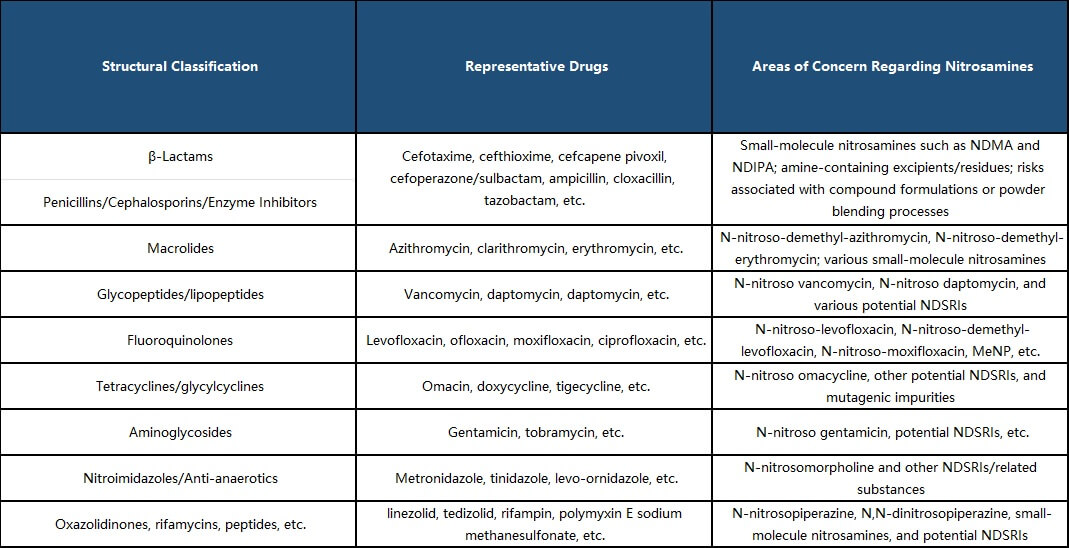
Note: The list above may be further refined based on specific product structures, manufacturing routes, excipients and packaging materials, storage conditions, and regulatory requirements; actual areas of focus may vary across different companies’ projects.
III. Milestone Pharma’s NDSRI Research on Antiinfective Drugs
Milestone Pharma has established a systematic research pathway for anti-infective drugs, covering risk assessment, derivation of potential structures, simulation studies, method development, method validation, and sample testing. This approach covers a wide range of product forms, including active pharmaceutical ingredients (APIs), injections, capsules, eye drops, ear drops, lyophilized powders for injection, tablets, and powder-for-suspension formulations.
Case 1: NDSRI Simulation Study for Gentamicin
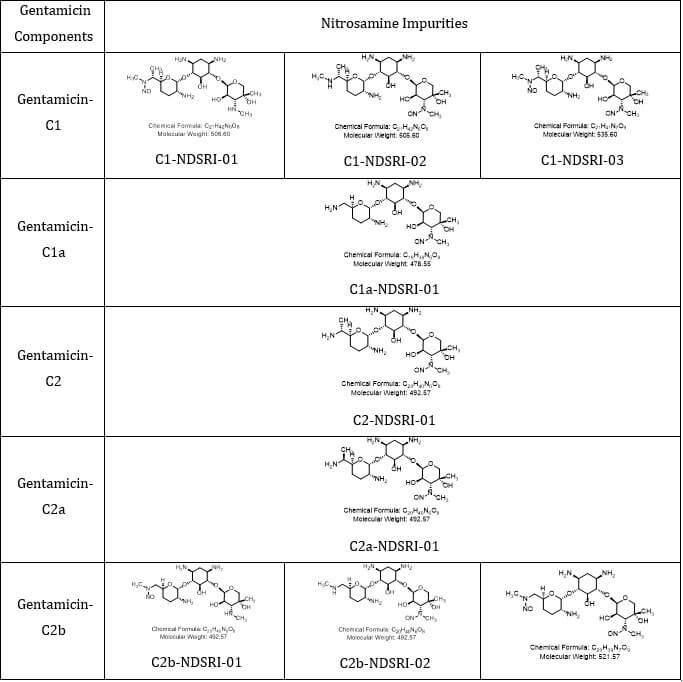
Gentamicin is a typical representative of aminoglycoside antibiotics and is a multicomponent fermentation product. Its structure contains multiple secondary amine groups, posing a high risk of nitrosation. In this study, by simulating the environment conducive to the formation of nitrosamine impurities, sodium nitrite was used to induce nitrosation reactions with materials and active pharmaceutical ingredients (APIs) containing secondary amines, and the reaction solutions were screened using high-resolution mass spectrometry (HRMS). Ultimately, impurities with higher signal intensity were selected for targeted synthesis to obtain impurity reference standards.
Table 1: Screening Table for Nitrosamine Impurities in Gentamicin
Case 2: Study on N-Nitrosovancomycin in Vancomycin
Vancomycin is a representative glycopeptide antibiotic; its NDSRI (N-nitrosovancomycin) has been included by the EMA in the Appendix 1 list for 2025, with an AI limit of 1,500 ng/day. Milestone Pharma’s trace analysis team successfully developed a method using LC-MS/MS to detect the N-nitrosovancomycin impurity in vancomycin hydrochloride injection, with a sensitivity of up to 0.078 ppm.
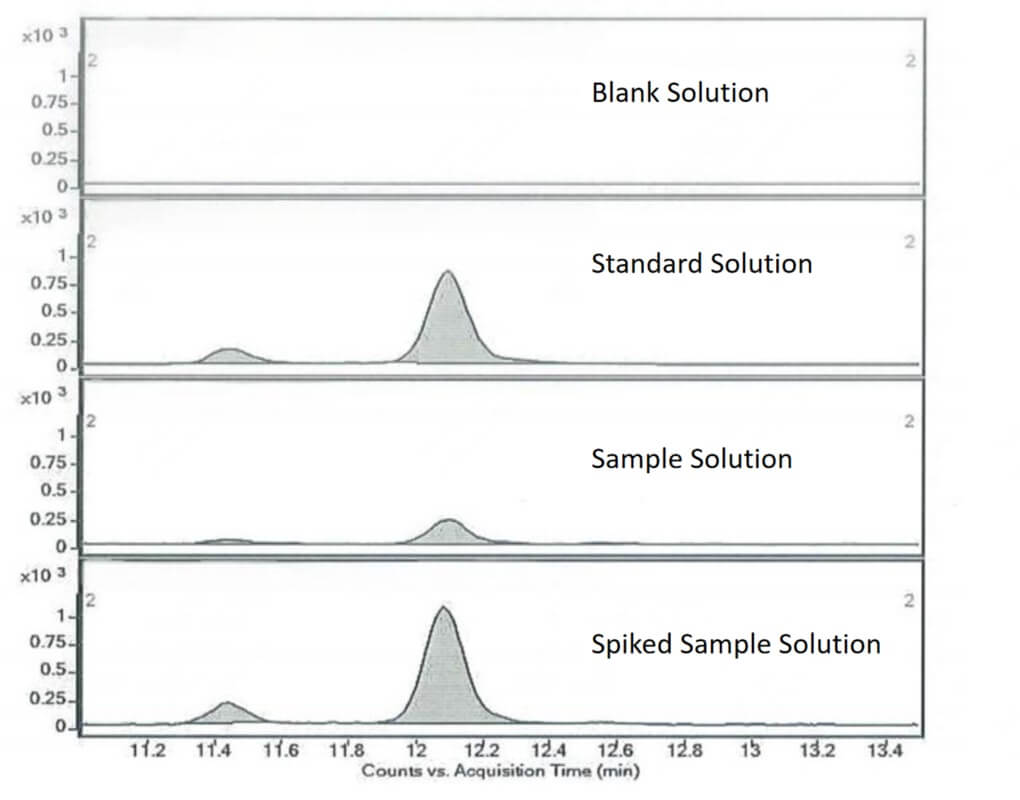
Specificity spectrum of N-nitrosovancomycin in vancomycin hydrochloride injection
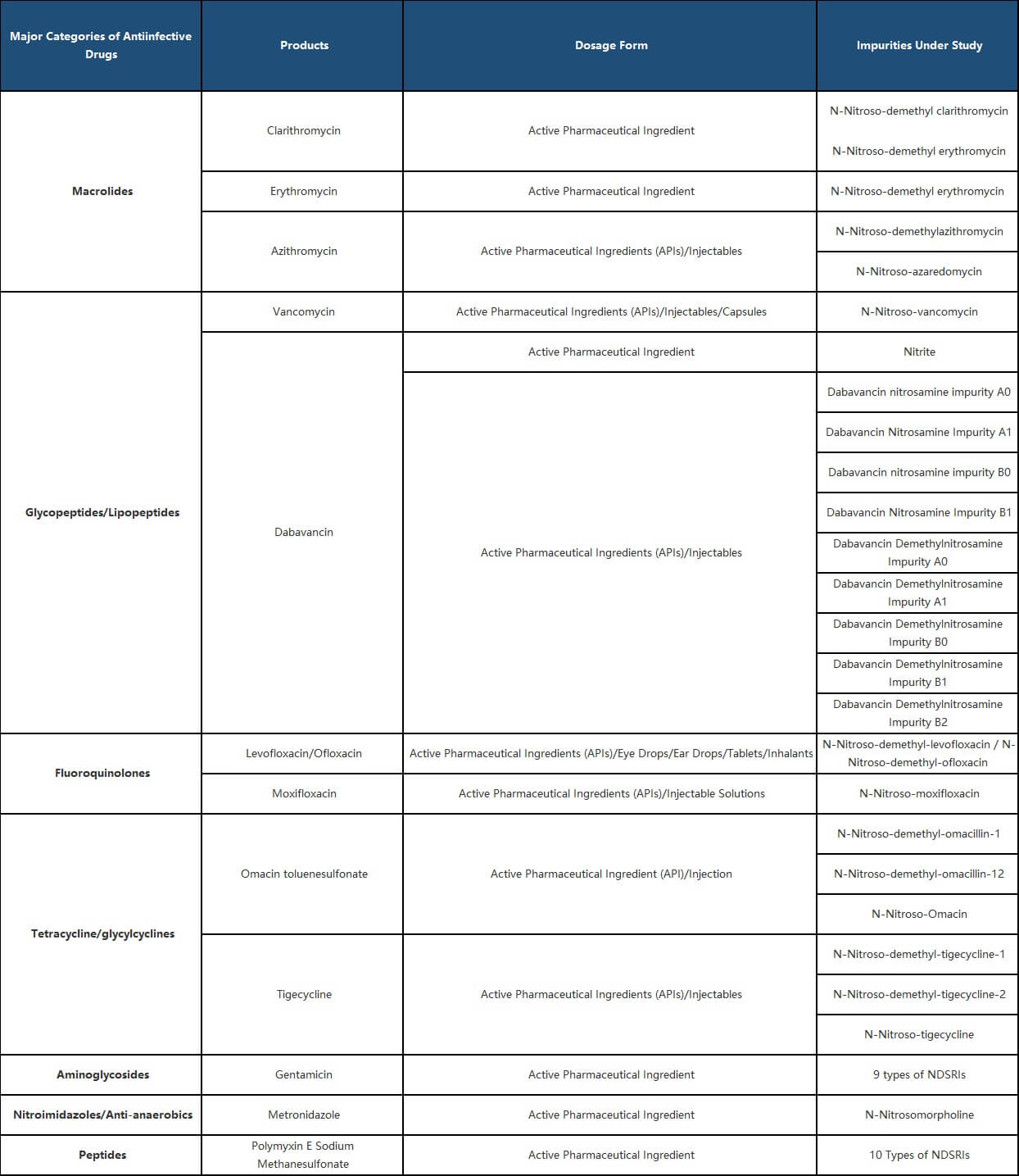
Examples of Milestone Pharma’s Capabilities in Nitrosamine Analysis of Antiinfective Drugs
The list shows a selection of our research projects. We are continuously building our team’s capabilities; please feel free to contact us for more information regarding customized services for additional compounds and impurities.
Conclusion
Milestone Pharma has accumulated practical data on dozens of compounds and hundreds of impurities in the field of NDSRI research for anti-infective drugs, establishing a comprehensive solution spanning “risk assessment—simulation studies—method development—compliance testing.” Whether it involves the detection of trace amounts of NDSRIs in complex fermentation products or the elimination of interferences in multi-component formulations, we can help clients significantly shorten research timelines and reduce compliance risks through efficient methodological responses and precise qualitative and quantitative capabilities.Moving forward, we will continue to push the boundaries of technology and strive to be the most trusted partner for pharmaceutical companies in nitrosamine research.

