





Solid dispersions (SDs) are highly effective in enhancing the dissolution of poorly soluble drugs; however, physical stability, process scale-up, and carrier selection remain the “three major hurdles” facing R&D professionals. The good news is that with the emergence of new carriers, advanced preparation technologies, and computational simulation tools, this field is shifting from “trial and error” to “precision design.” This article focuses on practical pain points and cutting-edge trends, making it ideal for in-depth reading by senior R&D and management personnel.
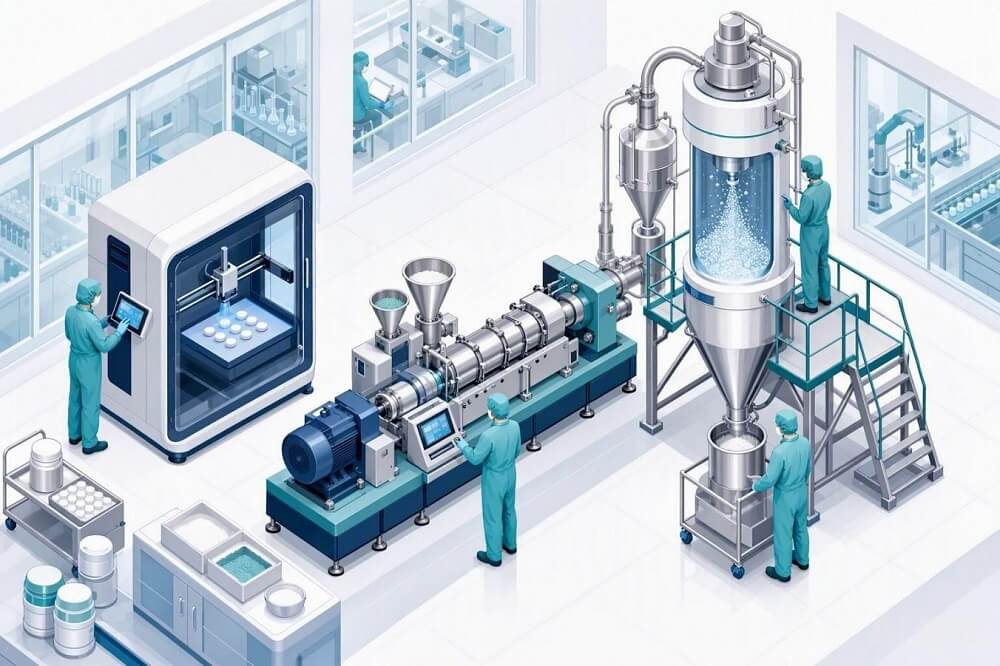
Figure 1: Smart Manufacturing of Next-Generation Solid Dispersions: 3D Printing, Continuous Extrusion, and Spray Drying
1. The Art of Carrier Selection: How to Choose the “Perfect Partner” for an API?
Selecting the right polymer carrier is key to the success or failure of amorphous solid dispersions (ASDs). Let us first look at a set of real-world industry data: Among the 48 ASD formulations approved by the FDA from 2012 to 2023, PVPVA (poly(vinylpyrrolidone-co-vinyl acetate)) led the way with 18 out of 37 “API–polymer” combinations, followed closely by HPMCAS with 11. Among these, PVPVA was used in 12 of the 13 hot-melt extrusion products, while 10 of the 11 products using HPMCAS as a carrier opted for spray drying—the carrier and the process are a natural match.
Common Carriers | Tg (approx.) | Hygroscopicity | Process Suitability | Properties and Precautions |
PVPVA / Copovidone | ~105 °C | Moderate | HME is the preferred choice; compatible with SD | Most widely used among approved products; good thermal stability and rheological properties; forms a gel layer easily upon contact with water; special attention required for tablet disintegration design |
HPMCAS | ~118 °C | Low | Preferred for SD, but more challenging for HME | Enteric polymer, pH-dependent release; outstanding crystal inhibition; may form ion pairs with weakly basic drugs, affecting drug release |
HPMC | ~155 °C | Low | Primarily SD | A classic carrier with good compatibility and a long history; the new-generation Affinisol® series improves HME processability |
HPMCP / Methacrylic acid copolymer (e.g., Eudragit® L100) | — | Low | Primarily SD | Enteric alternatives with commercial precedents emerging in recent years (e.g., Tolsura®, Phyrago®) |
Soluplus® | ~52 °C | Moderate | Suitable for both HME and SD | Amphiphilic graft copolymer with solubilizing properties; relatively low Tg; plasticizing effects should be evaluated in high-humidity environments |
PEG / Poloxamer, etc. | Crystalline, low melting point | — | Melt-processing / melt granulation | Representative of first-generation carriers; limited drug-loading capacity and stability, typically used for low-dose or early-stage products |
Key Considerations for Selection
• High Tg: Polymers with a higher glass transition temperature can effectively suppress molecular migration and delay recrystallization; plasticizers such as water can lower the system’s Tg, so a safety margin must be allowed.
• pH Dependence: For weakly basic drugs prone to precipitation in gastric acid, enteric carriers (HPMCAS, HPMCP) can shift the drug release “site” to the intestine, reducing interference from food effects and acid-reducing agents.
• Hygroscopicity: PVP is relatively hygroscopic; caution is required regarding plasticization and the resulting decrease in Tg under high-humidity conditions. In contrast, PVPVA and HPMCAS are more moisture-resistant.
• Molecular Weight: Higher molecular weight and viscosity may slow dissolution, requiring a trade-off between stability and release rate.
• Drug Loading and “Overlap Concentration c*”: Achieving high drug loading has been a key focus in recent years. The latest mechanistic studies indicate that when the polymer concentration is below the overlap concentration c*, a continuous “polymer-depleted” amorphous drug phase exists in the system, making crystallization difficult to suppress; when the concentration exceeds c*, a homogeneous polymer matrix can significantly delay the first nucleation event. This provides a quantitative framework for the rational design of high-drug-loading ASDs.
• Drug–Polymer Interactions: Hydrogen bonds can enhance miscibility and stability; however, weakly basic drugs and enteric carriers containing acidic groups may form hydrophobic ion pairs, which can actually hinder release—a two-way assessment is required during formulation design.
2. Three Major Challenges and Strategies for Addressing Them
From small-scale laboratory trials to commercial production, ASDs require a systematic resolution of three core contradictions: thermodynamic instability, unpredictability in process scale-up, and the tension between high drug loading and physical stability.
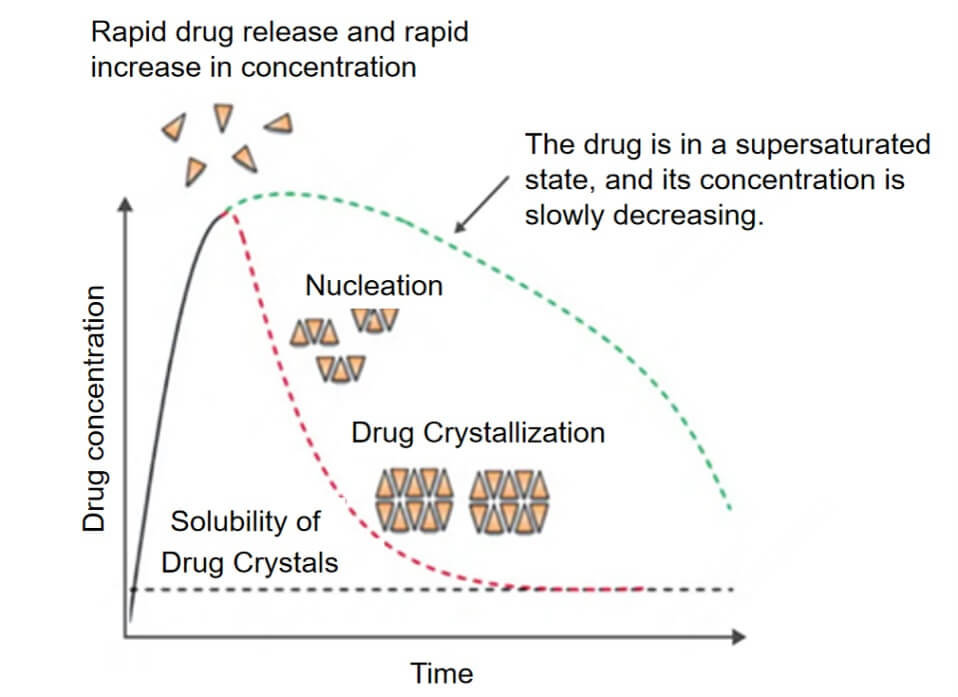
Figure 2: “Spring–Parachute” Model: Amorphous drugs rapidly reach supersaturation (spring), while precipitation inhibitors maintain sustained supersaturation (parachute)
Challenge 1: Physical Stability (Recrystallization and Phase Separation)
ASDs are thermodynamically metastable systems; fluctuations in temperature and humidity can easily induce phase separation and recrystallization. In addition to “crystallization,” liquid-liquid phase separation (LLPS) during dissolution is equally a cause for concern: supersaturated drugs first form drug-rich nanodroplets, and their stability directly determines the absorption “ceiling.”
Countermeasures: Ternary solid dispersions (introducing a third component such as a surfactant), carriers with better moisture resistance (e.g., HPMCAS), polymer blends, and nanoscale protective coatings on particle surfaces (e.g., atomic layer deposition); supplemented by accelerated stability testing and predictive analysis of Tg and Flory–Huggins interaction parameters.
Challenge 2: Difficulty in Process Scale-Up
Inconsistencies between laboratory and pilot-scale tests and scaled-up production (HME, spray drying) are a classic pain point in industrialization.
Countermeasure: Introduce Process Analytical Technology (PAT) and the Quality by Design (QbD) philosophy to monitor key process parameters (screw speed, barrel temperature, feed rate, etc.) in real time, ensuring batch-to-batch reproducibility. It is worth noting that continuous manufacturing has become a direction jointly encouraged by regulatory agencies in China, the U.S., and Europe, and hot-melt extrusion inherently possesses continuous processing characteristics; the latest research even uses melt rheology modeling to extrapolate extruder torque, enabling the prediction of “extrudability” as early as the formulation stage, thereby significantly reducing the trial-and-error costs associated with scale-up.
Challenge 3: Low Drug Loading
Traditional SD formulations typically have drug loadings below 30%–40%, resulting in excessively large tablet cores or capsules; as the drug loading increases, the risk of crystallization rises sharply.
Countermeasures: Use molecular dynamics (MD) simulations and Flory–Huggins solubility parameters to predict drug–polymer compatibility and identify the optimal formulation ratio in advance; apply the c* theory discussed above to guide high-drug-load designs; or employ a synergistic strategy involving polymer blends, plasticizers, and surfactants (e.g., adding plasticizers to ASDs containing drugs with high Tg to improve release).
3. Marketed Products and Innovative Preparation Technologies
The commercial viability of solid dispersions has been validated by multiple marketed products. Meanwhile, emerging technologies such as KinetiSol®, 3D printing, microfluidics, and slurry-based transformation are systematically addressing pain points such as “difficulty in scaling up, high energy consumption, and excessive solvent use.”
Generational | Representative Products | Carrier / Process | Comments |
First Generation (1970s–1990s) | Gris-PEG® (griseofulvin); Cesamet® (nabilone); Sporanox® (itraconazole) | PEG solvent evaporation; PVP HPMC fluidized-bed layering | Demonstrated the commercial viability of SD (Note: Sporanox uses a fluidized-bed layering process, not hot-melt extrusion) |
Second Generation (2000s–2010s) | Intelence®, Kaletra®, Zelboraf®, Noxafil® | PVPVA / HPMCAS; HME / spray drying | The SD and HME platforms have taken shape, and ASD has become the mainstream |
Third Generation (past five years) | Venclexta®, Lynparza®, Erleada®, Phyrago®, Sunlenca® | New carriers + new dosage forms (pediatric granules, PowderMix) | Patient-centered approaches, fixed-dose combinations, and co-amorphous formulations are being explored in parallel |
The trends in R&D and commercialization are equally clear: among the 48 approved products, tablets account for approximately 75%, and fixed-dose combinations (FDCs) account for approximately 38%; granules, oral suspensions, and powders for children and patients with swallowing difficulties are on the rise—“patient-centered” has become the new standard for ASD product development.
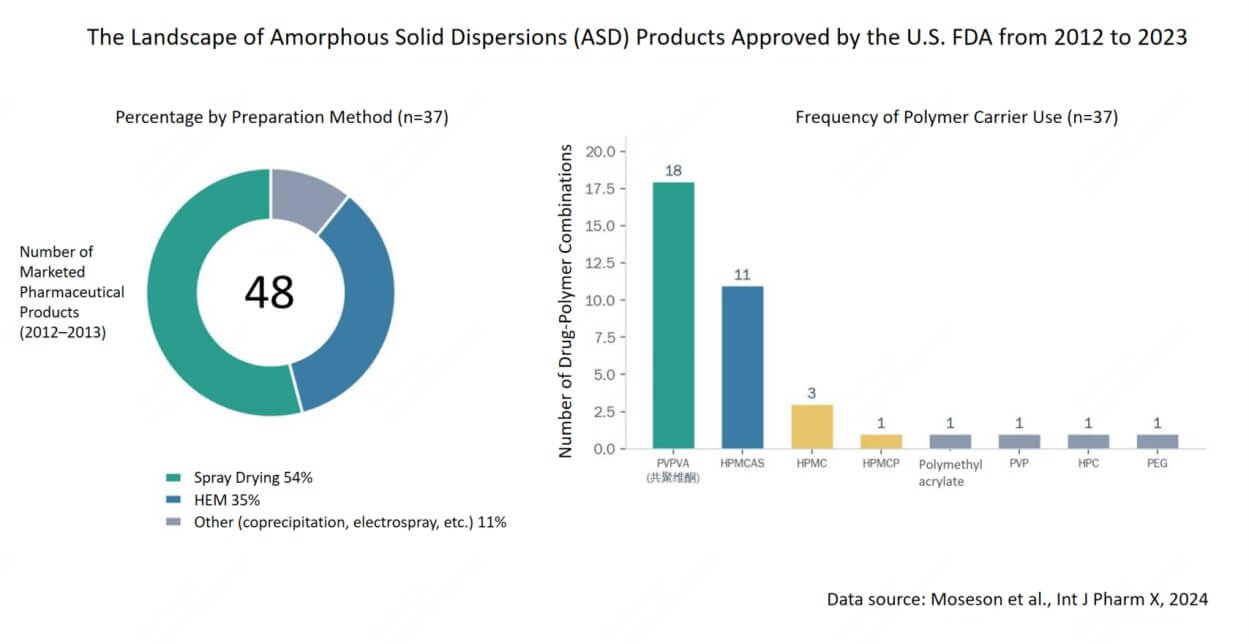
Figure 3: Landscape of Formulations, Processes, and Carriers for FDA-Approved ASD Products, 2012–2023
Overview of Cutting-Edge Preparation (Manufacturing) Technologies
• KinetiSol®: A solvent-free, high-speed friction-heating process that is not limited by drug melting point or solvent compatibility; it is particularly suitable for high-melting-point or heat-sensitive drugs and is considered a leading candidate to replace solvent-based methods.
• Electrospraying: Atomizes the feed solution using electric field forces, offering a wider range of solvent options than spray drying.
• Supercritical Fluid Technology (SAS/RESS): Solvent-free and mild processing conditions.
• Coprecipitation (cPT): Replaces evaporation with precipitation, offering a wider solvent window and facilitating rapid progression to clinical trials.
• 3D Printing (Additive Manufacturing): Fused Deposition Modeling (FDM) enables personalized dosing and complex drug delivery structures; terahertz spectroscopy has been used for online detection of the crystallinity of printed ASDs.
• Microfluidics and Acoustic Fusion: High-throughput formulation screening combined with rapid, solvent-free fusion accelerates the “funnel” convergence in early-stage development.
• Slurry-Based Transformation: Room-temperature, low-solvent, and scalable, this method holds promise as a universal platform for the green production of ASDs.
4. The Future Is Here: Computer-Aided and Intelligent Design
• Molecular Dynamics (MD) Simulation: Predicts drug–polymer compatibility, intermolecular forces, and Tg at the atomic level, enabling virtual carrier screening and complementing thermodynamic models such as PC-SAFT.
• Machine Learning (AI): From random forests to deep learning, the accuracy of models predicting the physical stability of ASDs has reached over 82.5%; integrated platforms such as PharmSD link data-driven ML, molecular modeling, and PBPK, covering the entire workflow from “co-former screening—carrier optimization—process prediction”; the efficiency of co-former compatibility screening for co-amorphous systems has also been significantly improved.
• Physiologically Based Pharmacokinetic (PBPK) Models: By integrating in vitro dissolution and supersaturation data, these models predict human absorption in advance, guiding formulation optimization and food effect assessment, and are becoming a “digital bridge” connecting in vitro and in vivo studies.
• Co-Amorphous Systems (CASD) and Regulatory Science: Drug-small-molecule co-amorphous systems (such as amino acid co-amorphous systems) eliminate the need for polymer carriers while enhancing stability; multiple projects have already entered the clinical phase.

Figure 4: Computer-Aided and AI-Driven Formulation Design for Solid Dispersions
5. Key Recommendations for Industrial Implementation
For teams seeking to move ASDs from the laboratory to the production floor, the following points are particularly important:
· Introduce QbD early: Define critical quality attributes (CQAs) during the formulation screening stage and establish causal relationships between CQAs and formulation/process parameters.
· Implement PAT and continuous manufacturing: Use online monitoring techniques such as near-infrared (NIR) and Raman spectroscopy to monitor material status in real time and reduce the risk of batch failures.
· Establish an accelerated stability + PBPK evaluation system: Predict long-term physical stability and in vivo performance within a short timeframe to accelerate decision-making.
· Focus on regulatory and patent strategies: The crystal form, amorphous form, and manufacturing process of ASD may all involve intellectual property planning; at the same time, thorough communication with regulatory authorities regarding dissolution methods and stability data is necessary.
Conclusion
After more than six decades of evolution and progress, solid dispersions have evolved from “simple co-melting” to “precision design,” growing from a laboratory technique into an industrial platform supporting dozens of blockbuster products. Through the combined power of new materials, innovative processes, and intelligent algorithms, bottlenecks in stability and scale-up are being systematically overcome—accelerating the process of unlocking the clinical value of more poorly soluble drugs.

